
Solo Economy
Sell what you gather and buy what you need, at a market whose prices move with supply and demand.
截图
介绍
A real market for single-player worlds. Sell what you mine, farm and loot. Buy what you need. Prices react to what you’ve been doing, so dumping a chest of diamonds tanks the diamond price and buying up iron makes it climb.
Multiplayer servers get an economy for free: other players. Solo worlds don’t, and trading is whatever villager offers you happen to roll. Solo Economy gives you a market that will buy almost anything you bring it and sell you almost anything you’re missing.
Getting started
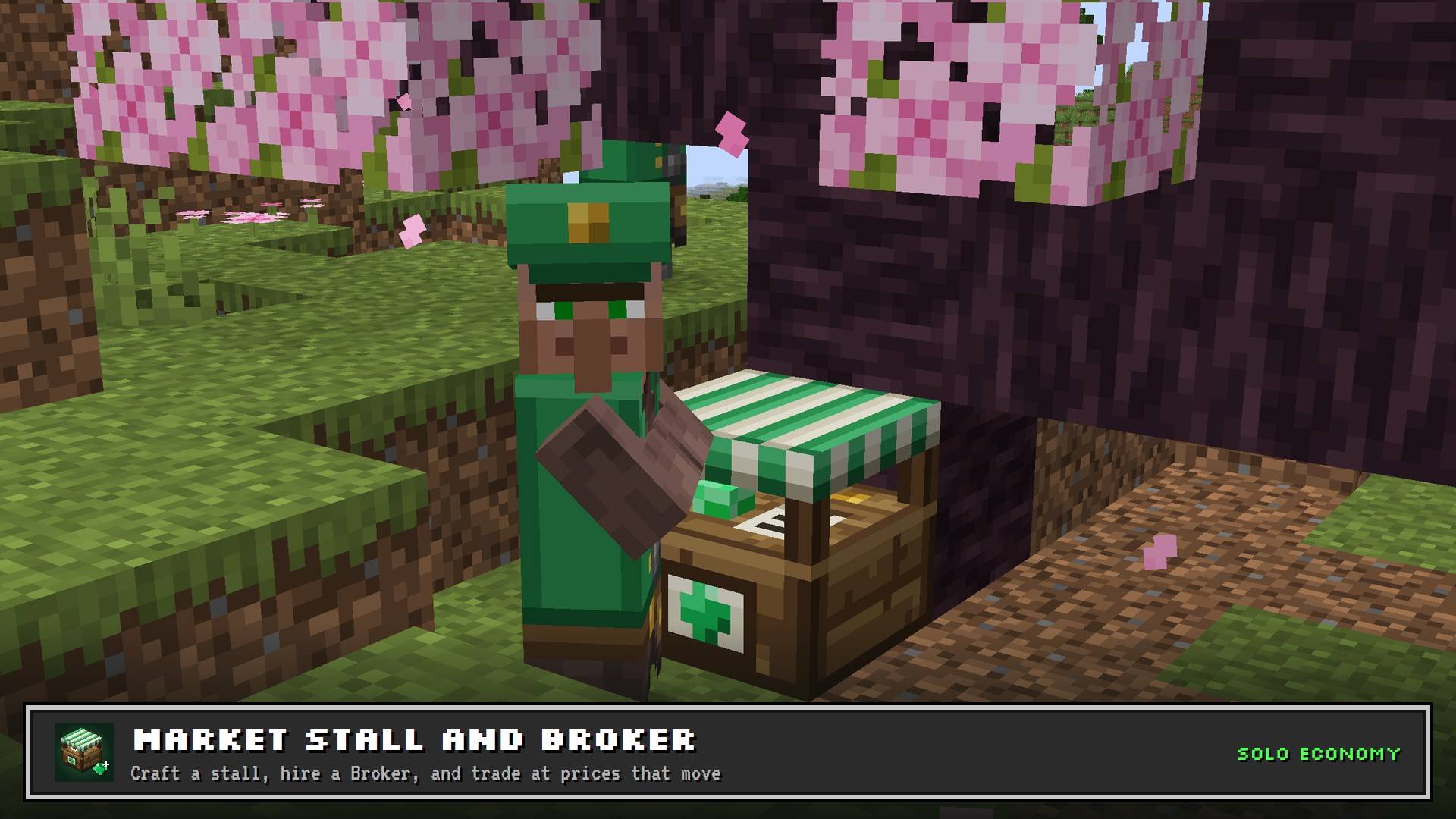
Craft a Market Stall from 5 planks, a chest and an emerald.
Right-click it to open the market.
Deposit your emeralds, then click the Sell or Buy price on any row.
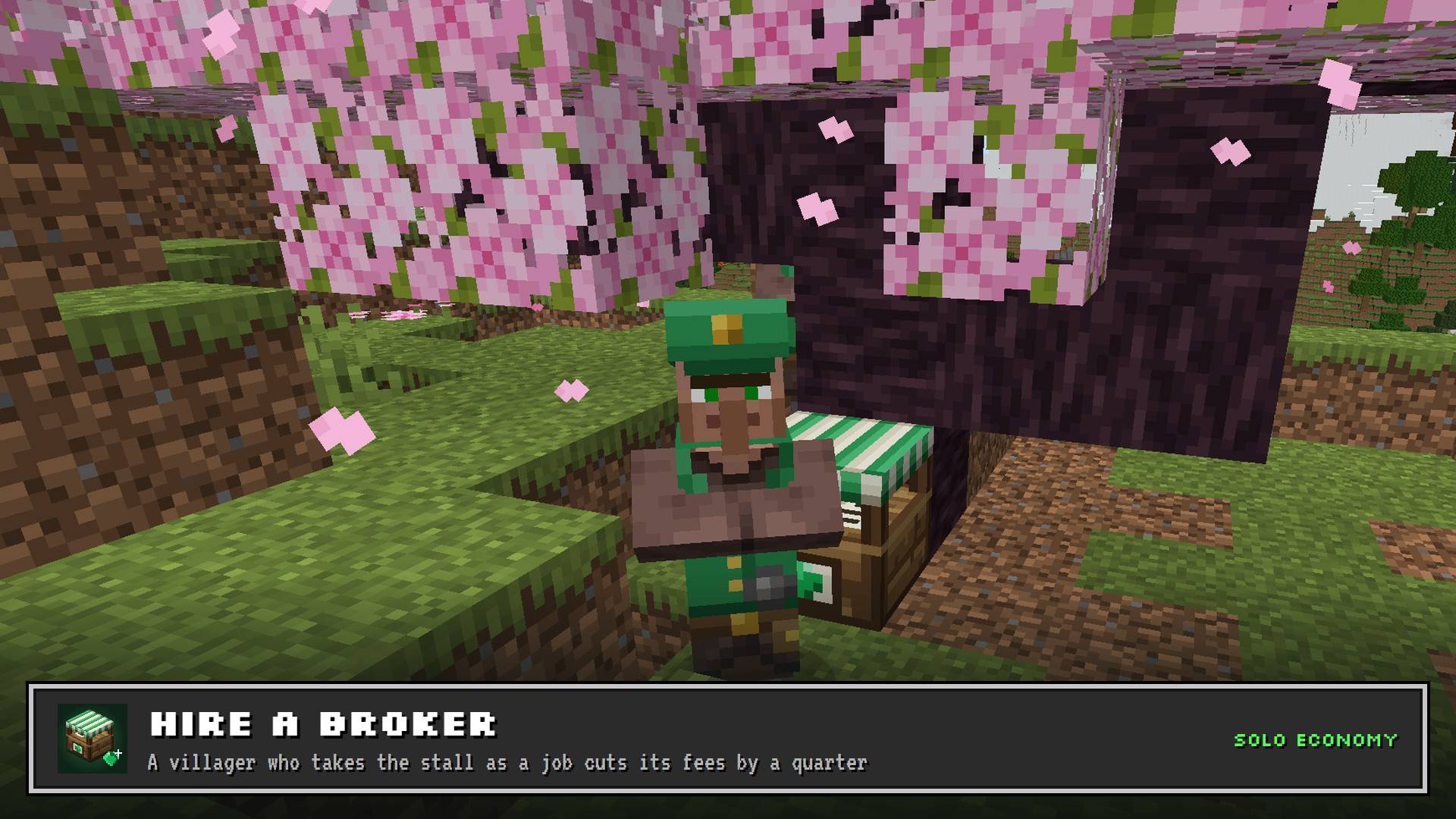
Hire a Broker (optional). Place the stall near an unemployed villager. They’ll take the job, and trading at that stall gets 25% cheaper.
Features
🏪 Market Stall
A block that opens the market. It works on its own, and a villager can take it as a job site.
🧑💼 Broker villager
A new villager profession. A Broker working a stall cuts that stall’s trading fees by a quarter, so hiring one is a real upgrade rather than decoration.
💎 Emerald account
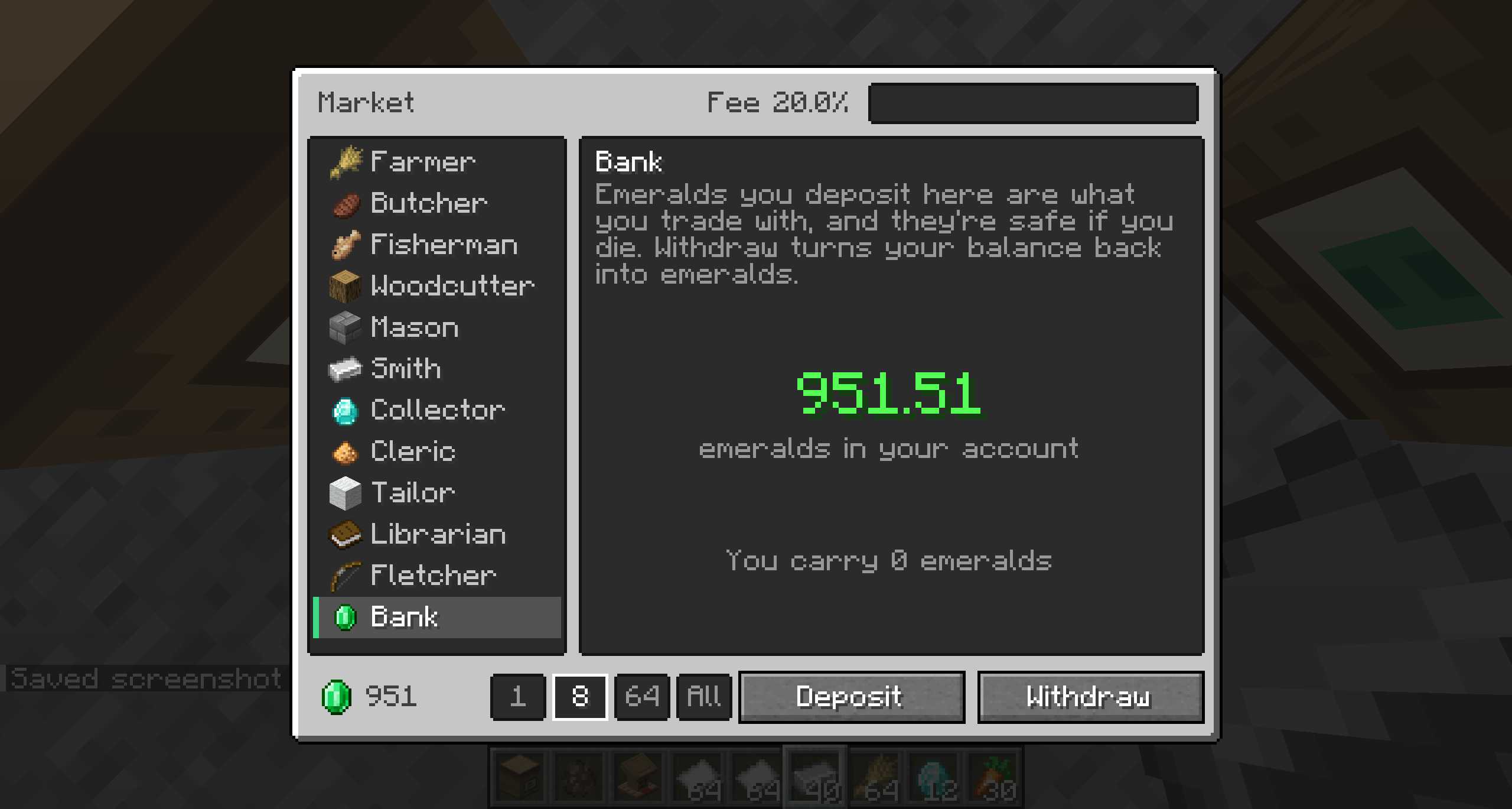
Emeralds are the currency, kept as a balance rather than in your inventory, so a big sale never buries you in stacks. Deposit and Withdraw at any stall, always 1:1. Your balance is shown in the corner of your screen.
🔎 The market screen
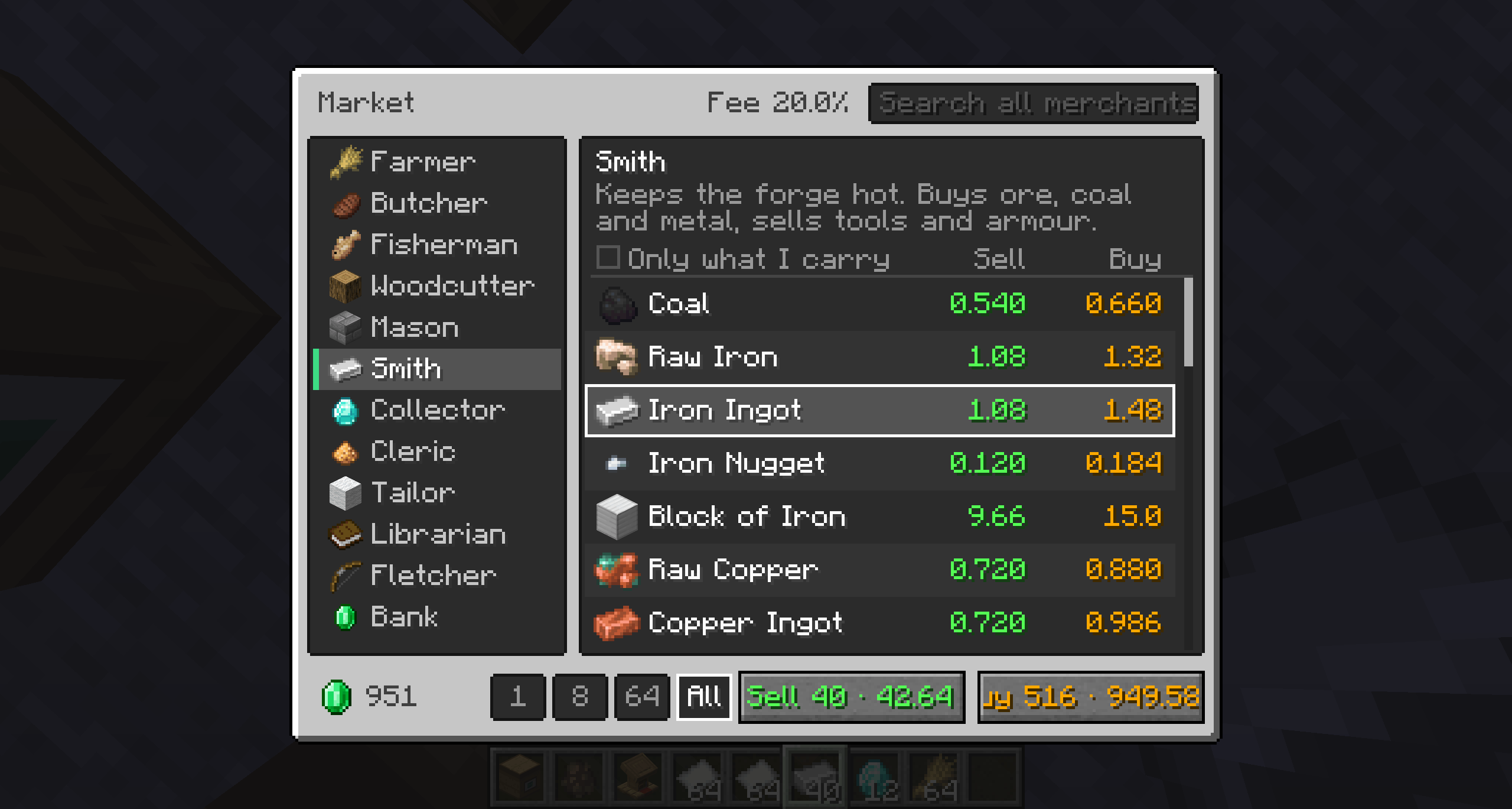
Search, sort (A–Z, cheapest, priciest), and an In bag filter that lists only what you’re carrying
Scrolling list with a draggable scrollbar
Quantity buttons: 1, 8, 64, or All. All sells everything you’re carrying, or buys as many as you can afford
Cost preview: hover any row to see the exact total before you click
Supply tooltips tell you whether an item is oversupplied or in demand right now
📈 Prices that move
944 tradeable items in vanilla
Selling lowers the price, buying raises it. A stack of diamonds moves the diamond price about 15%. Cheap goods like dirt have deep markets and barely move, but a double chest of dirt still will.
Markets recover halfway back to normal every in-game day, so a market you flooded on Monday is worth revisiting by Wednesday.
Bulk trades are priced unit by unit, so selling 64 at once is never worse than selling them one at a time. There’s no reason to click 64 times.
🧱 Crafted items are priced from their ingredients
About 225 raw materials have set prices. Everything else is priced from the ingredients of its cheapest recipe:
A diamond block is worth its nine diamonds. Selling one moves the diamond price exactly as selling nine diamonds would.
Selling pays for the materials. Buying something pre-made adds a small fee per crafting step, so crafting it yourself always saves.
Crafting isn’t a money machine. Buying ingredients to craft and sell loses a little at normal prices, so your income comes from gathering, not from gaming the prices.
For modpack makers
Configuration lives in config/soloeconomy-server.toml:
Setting Default What it does
spread 0.10 The market’s cut on every trade
craftMarkup 1.12 Fee per crafting step when buying pre-made goods
elasticity 0.6 How strongly prices react to supply
marketDepth 1024 How much trading it takes to move a price
recoveryPerDay 0.5 How fast markets return to normal
minPriceMultiplier / maxPriceMultiplier 0.2 / 5.0 Price floor and ceiling
brokerSpreadMultiplier 0.75 Fee reduction when a Broker works the stall
startingBalance 0 Emeralds a new player starts with
Custom prices: add a datapack with data/soloeconomy/base_prices.json to change or add prices. Packs stack, and changes apply on /reload. Only set prices for raw materials; crafted items are priced from their ingredients automatically.
Pricing check: every time prices load, the mod checks every recipe. If a pricing change makes any item profitable to craft and sell, it logs an error naming the recipe.
What can’t be traded
Emeralds and emerald blocks. Use Deposit and Withdraw instead.
Damaged, enchanted or renamed items, and containers with items inside
Water buckets, and creative-only blocks such as bedrock and spawners
Known limitations
This is an early release.
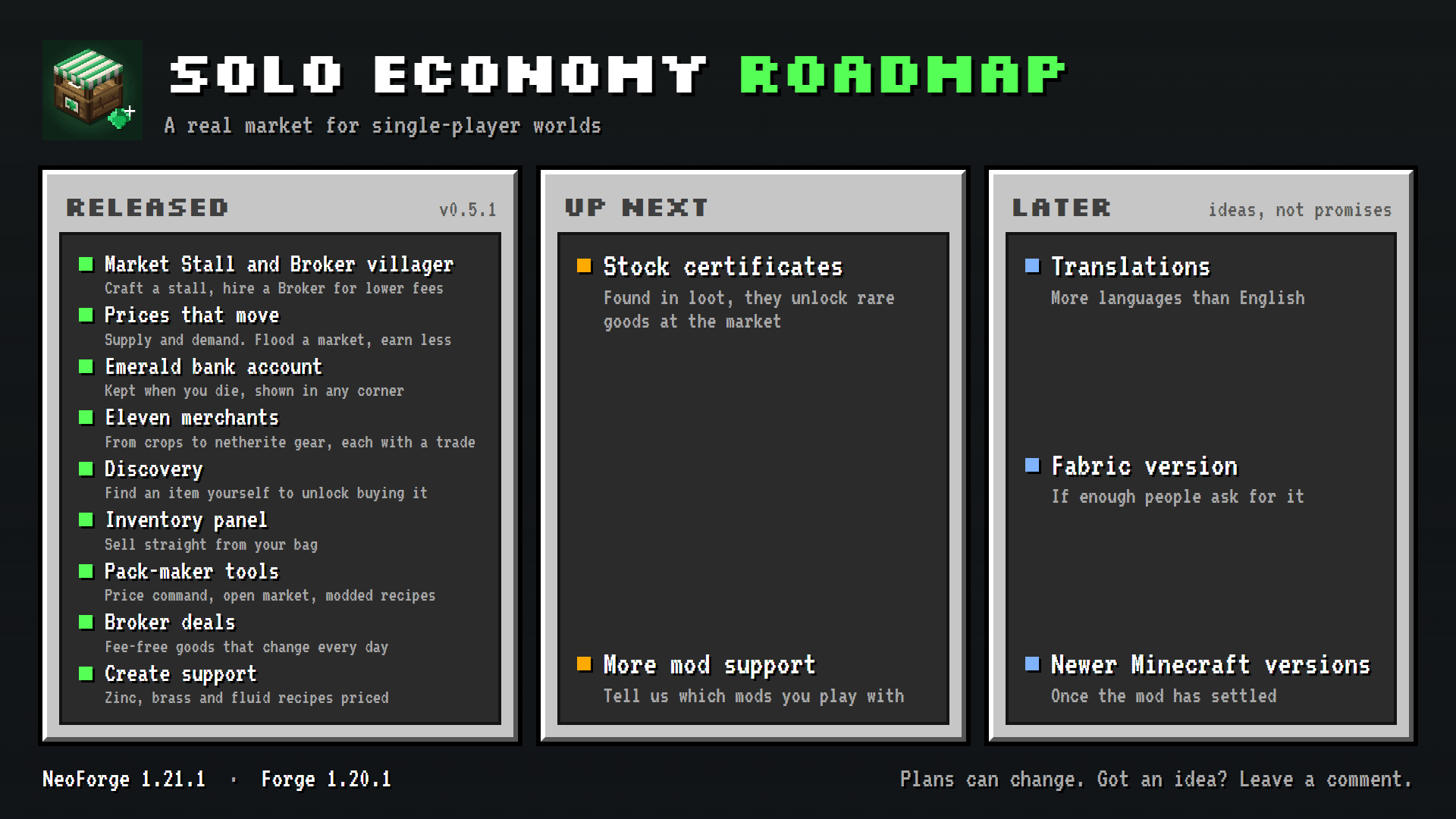
Placeholder art. The stall and Broker textures are temporary.
Not yet tradeable: netherite tools and armour (smithing recipes aren’t supported yet), potions, spawn eggs, music discs, pottery sherds and smithing templates.
Modded items are mostly untradeable unless a datapack gives their raw materials prices.
The balance display sits in the top-right corner and may overlap a minimap.
Built for single-player. On a server, all players share one market.
English only.
Requirements
Minecraft 1.21.1
NeoForge (built on 21.1.209)
Required on both client and server
Found a bug or a price that looks wrong? Leave a comment. If you’ve found a way to make money from nothing, I especially want to hear about it.
常见问题
Solo Economy 支持哪些 Minecraft 版本?
Solo Economy 支持 Minecraft Java 版 1.20.1–1.21.1,共 2 个版本,可用的加载器:Forge / NeoForge。下载时注意选择和你游戏版本一致的文件。
Solo Economy 怎么安装?
先用 PCL2 或 HMCL 启动器安装对应版本的 Forge / NeoForge,再把下载的 .jar 文件放进游戏目录的 mods 文件夹,重新启动游戏即可。开启了版本隔离的,mods 文件夹在 versions/版本名 下面。
LLSTEELO 的其他作品
查看全部 →
MINEBHOP
Bring CS2-style bunny hopping to Minecraft. Chain jumps, preserve momentum, air strafe, and build speed with skill-based movement. Master the mechanics and fly across your world faster than ever.
Steelo’s Classes
Choose your starter class.
Steelo’s Skill Tree
A Minecraft skill progression mod with four paths: Mining, Fighting, Defense, and Other. Earn Skill Points, unlock powerful abilities, and customize your playstyle with upgrades that make you stronger, faster, tougher, and more efficient.

Steelo’s Progressions: Constellation
Progression as a star chart: earn points from deeds, then light stars to unlock crafting, gear, workstations and dimensions.
评论
登录后评论和评分