Harvestweald Lite
Harvestweald Lite brings more variety to farming in Minecraft with new crops, fruit trees, delicious meals, and useful farm machines. Grow your homestead, fill your pantry, and enjoy the cozy rhythm of farm life!
介绍
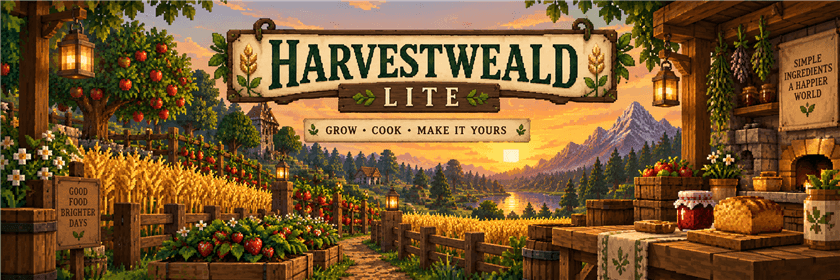
54 FIELD CROPS + 13 FRUIT TREES · 92 FOODS & DRINKS 9 KITCHEN STATIONS · 181 KITCHEN PROCESSES
Minecraft Java 26.3 / 1.20.1 · Fabric · Lite 1.7.1
A little plot. A full pantry. A place to call home.
Grow vegetables, tend an orchard, keep bees near the harvest and turn your produce into flour, preserves, cheese and full meals. Harvestweald Lite connects planting, soil care, useful tools, farm machines and cooking into one farm-to-table loop.
The Lite rules: crops and fruit trees grow in every biome without seasons, a calendar or climate restrictions. Suitable ground, light, water, trellises and space still matter. Irrigation channels are absent; rain barrels supply adjacent sprinklers directly.
MINECRAFT 1.20.1 FABRIC PORT
A dedicated Java 17 build brings the Lite farming, soil-care, tools, kitchen, handbook, bees and village features to Minecraft 1.20.1. Choose the file matching your Minecraft version. Newer vanilla structure decorations use 1.20.1 equivalents; copper golems are unavailable in that version.
WHAT’S NEW IN 1.7.1
This release brings the 1.7 farming tools and soil-care update to CurseForge, together with the 1.7.1 texture improvements.
- Live inspection card: hold the soil probe to see growth, seed vigor, moisture, fertility, mulch, crop-rotation advice and physical growth obstacles.
- Working-area previews: see the harvester’s 5×5 area and sprinkler’s 9×9 area before placing them.
- Gardener’s Bag, Hand Seeder, Harvest Sickle and Orchard Shears: carry supplies, plant rows and gather ripe harvests.
- Straw mulch and visible soil quality: keep moisture longer and recognise poor, ordinary and rich ground.
- Matching pixel art: five new item sprites and 96 soil textures reworked on a crisp 16×16 grid, using the mod’s established palettes.
- Seven illustrated handbook chapters with Russian and English text.
01 · PLANT, GROW & HARVEST
Choose from 54 field crops and 13 fruit trees: grains, vegetables, roots, legumes, berries, herbs, mushrooms, orchard fruit and nuts. Grow rye, rice, corn, broccoli, spinach, asparagus, sesame, peanuts, strawberries, apples, citrus and more, each with uses in the kitchen.
- Ordinary crops: prepare farmland and provide suitable light. Most non-mushroom plants need enough light to survive.
- Rice: needs an actual water block nearby. Moist soil or a sprinkler alone does not meet this requirement.
- Climbing crops: place a trellis directly beside them horizontally.
- Mushrooms: use suitable ground or logs and shade; excessive light stops their growth.
- Tall crops: leave the block above clear for the upper half.
- Fruit trees: plant a sapling with room for the crown. Leaves pass through visible fruit stages.
Right-click ripe mod crops or ripe fruit leaves to harvest. Crops remain planted and fruit leaves remain on the tree. Bushes and climbing plants restart partway through their cycle; other field crops restart from their first stage. Bone meal advances crops and fruit leaves and grows saplings when their physical requirements and space are satisfied.
Finding your first seeds
Discover wild plants in suitable newly generated areas, buy planting supplies from farmers, or find a Seed Pouch while breaking grass or ferns in survival. Right-click the consumable pouch for four random selections: three seeds for a field crop or one sapling for a tree per selection. This random pouch is separate from the reusable Gardener’s Bag.
02 · SOIL, COMPOST & CROP ROTATION
Use a hoe on already tilled farmland, apply compost to farmland, or craft Farm Soil. Improved soil tracks moisture and fertility from 0 to 7 and remembers the family of the last harvested crop. It stays usable when dry, while better moisture and fertility increase natural crop growth.
- Harvesting an ordinary crop from a different family costs 1 fertility.
- Repeating its previous family costs 2 fertility.
- Legumes restore 2 fertility, up to 7.
- Compost restores 3 fertility, up to 7. Applying it to ordinary farmland upgrades that soil.
Rotate grains, vegetables, roots, legumes, berries, herbs, fruit and fungi. The probe shows the previous family and suggests alternatives, prioritising legumes on poor soil where appropriate.
Turn byproducts back into soil care
Grain harvests produce straw; other field crops produce plant scraps. Put straw, plant scraps or oilcake into a vanilla composter to advance its fill. When it is ready, use an empty hand to collect two compost.
Straw mulch
Craft 3 straw → 3 mulch and apply one mulch to an improved soil block. Mulch reduces the chance of moisture loss to one quarter of the uncovered chance; it does not create water. Applying more to an already covered block costs nothing. The cover persists through harvesting, composting and saving the world.
03 · BEES, POLLINATION & BETTER SEEDS
Keep live bees close to your crops and orchard. Lite checks for a living bee in the nearby area extending approximately six blocks from the harvested plant or leaf block along each axis. A bee inside a hive is not a nearby flying entity for this check.
- Fruit-family crops, berry crops and trellis-grown crops: a nearby bee adds one extra produce item to a ripe harvest.
- Fruit-tree leaves: their normal 1–2 fruit harvest becomes 2–3 fruit with a nearby bee.
- Field-crop seeds: at harvest, a nearby bee gives a 1 in 12 chance to increase the dropped seeds’ vigor by one level, up to 3.
One nearby bee is enough; additional bees do not multiply the bonus. Place hives and flowers near your growing area so bees can be present when you gather the harvest. These are harvest-time bonuses: bees are useful beyond honey production.
Seed vigor: 0–3
Plant improved seeds to carry their vigor into the crop. Higher vigor increases its natural growth chance, and plants at vigor 2 or 3 yield one additional produce item. Harvested seeds retain the plant’s vigor and can improve through the bee bonus. The Hand Seeder preserves seed quality.
04 · YOUR HAND TOOLS
- Soil Probe: hold it in either hand and aim within six blocks at soil, a crop, a sapling or fruit leaves. The in-game card shows relevant server data, obstacles and rotation advice. Remaining growth is an approximate range under current conditions, not a fixed countdown.
- Watering Can: fill it at water for 64 charges. Use it on a growing plot to hydrate a 3×3 area; successful watering uses one charge. Sneak-use near water can refill it too.
- Gardener’s Bag: right-click to open 27 filtered slots for planting items, saplings and fertilizers such as bone meal, compost and mulch. Contents stay with the bag when you close it or reopen the world. Close its screen before moving the active bag; nested bags and ordinary tools are rejected.
- Hand Seeder: right-click soil to plant up to five cells in your horizontal facing direction. Uses one chosen seed stack: offhand first, otherwise a suitable inventory stack. Occupied or unsuitable cells are skipped. It does not pull supplies from a closed bag. Durability: 256 successful plantings.
- Harvest Sickle: gather ripe supported crops in a 3×3 horizontal square. Mod plants stay planted; supported vanilla wheat, carrots, potatoes and beetroots are replanted using their actual drops. Unripe plants stay untouched. Durability: 384 successful harvests.
- Orchard Shears: collect ripe fruit leaves in 3×3×3, preserving leaves and unripe fruit. Durability: 384 successful leaf harvests.
Area tools spend seeds and durability only on successful actions, stop when they break and operate in loaded surroundings. Creative mode preserves their supplies and durability. A tall crop counts as one harvest, including when you target its upper half. Tool harvests drop their produce nearby.
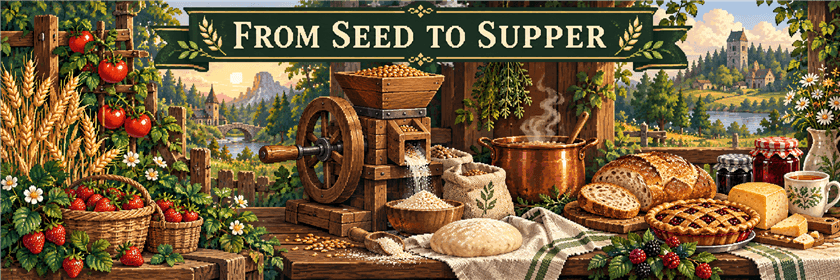
05 · NINE STATIONS, 181 KITCHEN PROCESSES
Turn your harvest into 92 foods and drinks, from flour and dough to pies, pizza, soups, cheese, jams and expedition meals. Each station starts a matching recipe automatically when its ingredients, required fuel and output space are available.
- Cutting Board: ingredient preparation, dough and assembled meals.
- Mill: flour from grain.
- Press: oil and juices.
- Cooking Pot: porridge, soups, stews and cooked meals. Uses fuel.
- Skillet: pancakes and fried dishes. Uses fuel.
- Farm Oven: bread, pies, pizza and oven dishes. Uses fuel.
- Preserving Barrel: jams and preserves.
- Cheese Vat: dairy and plant-based preparations, including cheese, cream, butter and yogurt.
- Drying Rack: dried ingredients and fruit. Uses fuel.
Example: mill 2 rye into 2 flour; combine 2 flour and a water bucket at the Cutting Board for 4 dough; bake 2 dough, 3 strawberries and 1 sugar in the Farm Oven for 2 berry pies.
Stations have the needed ingredient slots, fuel where applicable and one output slot. A full or incompatible output pauses work without spending ingredients or fuel. Returned buckets and bottles go into a freed input slot or drop nearby. There are no recipe pages, queues or hidden output buffers.
Food effects and drinks
More elaborate recipes can give short level-I regeneration, speed, resistance or haste. The exact effects and durations appear in the handbook and tooltips: for example, coffee grants Speed I for 30 seconds, and rice with tofu grants Haste I for 30 seconds. All 19 drinks use drinking animations and water-drinking sounds and can be consumed at full hunger.
06 · WATERING & FARM AUTOMATION
Rain Barrel → Sprinkler
The Rain Barrel holds 16 buckets, collects rain under an open sky and transfers water to directly adjacent sprinklers. The Sprinkler holds 4 buckets and hydrates farmland in 9×9, checking soil at its own height and one block above or below. Both can be filled manually with water buckets. Sprinklers spend water when they actually hydrate dry farmland. Lite has no channel network.
Mechanical Harvester: 5×5
Supply fuel and leave room in its single produce slot. The harvester checks a 5×5 plot, from one block below to two above the device, collecting mature supported crops and reachable ripe fruit leaves. It preserves mod planting and reserves a replanting item for supported vanilla crops. Main produce goes into the output; seeds and other byproducts drop beside the machine. A blocked output preserves that crop and its fuel cost.
Hold a harvester or sprinkler to preview the placement area; aiming at an installed device shows its area too.
Hoppers, redstone and storage
- Kitchen stations: hoppers above supply ingredients; side hoppers supply fuel where required, or ingredients at stations without fuel; bottom hoppers extract results.
- Redstone: a signal pauses machines.
- Grain Sacks, Produce Crates and Cheese Racks: each is a 27-slot storage block.
- Garlic Bundles: a decorative finishing touch for the farm.
- Greenhouse Heater: retains its fuel-driven operation and animation, but is not needed to overcome seasons or cold in Lite.
Machines need their chunks to be loaded. Old 27-slot machine inventories migrate into the compact layout; items that cannot fit drop beside the machine once.
07 · ANIMALS, FARMERS & PLACES TO EXPLORE
Animal Feed: right-click a baby animal to advance its growth, or a breeding-ready adult to put it into love mode. A successful use also restores 4 health points and consumes one feed.
Farmer trading: interacting with farmer villagers adds planting-supply offers and produce buyback offers. A Seed Pouch costs 3 emeralds. Each farmer offers a selection of seeds or saplings and buys 24 of their corresponding produce for an emerald. Offers retain normal limits and restocking.
Explore farmsteads, old mills, apiaries and abandoned orchards. New villages can receive farm plots, orchards and compact greenhouses adapted to plains, desert, savanna, taiga and snowy styles. A greenhouse is one possible village piece; it is not guaranteed in every village. Existing chunks and villages are not rebuilt by an update.
With commands enabled, use /locate structure #livingfarm:farms for farm landmarks, or search individually for livingfarm:farmstead, livingfarm:old_mill, livingfarm:apiary or livingfarm:abandoned_orchard. The special command /locate structure livingfarm:greenhouse searches actual village greenhouse pieces, within a bounded search area. It may report no match if none of the searched villages contains one.
08 · YOUR GUIDE, RECIPES & SETUP
The illustrated handbook is issued automatically on your first join and contains seven chapters, a crop/tree atlas, tool instructions and the kitchen recipes. Russian and English names, interfaces and handbook text follow the Minecraft language setting. The mod has its own creative tab.
Optional JEI integration includes all 181 kitchen processes and growing requirements; the new ordinary tool and mulch crafting recipes are available through the normal crafting-recipe viewer.
Minecraft 26.3: Java 25, Fabric Loader 0.19.5+ and Fabric API 0.162.0+26.3. Optional recipe viewer: JEI 31.12.0.65 with Mezz Config.
Minecraft 1.20.1: Java 17, Fabric Loader 0.19.5+ and Fabric API 0.92.12+1.20.1. Optional recipe viewer: JEI Fabric for 1.20.1 (tested with 15.74.0.228). Use matching Minecraft/mod files on the client and server. Back up worlds before changing mods; this port does not downgrade 26.3 worlds.
Keep only one edition of livingfarm in a mods folder. Lite’s farming growth speed can be adjusted through growthMultiplier in config/livingfarm.json; valid values are greater than 0 and no more than 20, with a default of 1. Seasonal settings from older configurations are ignored.
This description covers Lite 1.7.1. Seasons, climate restrictions, irrigation channels, a seed-breeding workbench and a complete village replacement are not features of this release.
Plant something new. Cook something good. Make yourself at home.
The two banner images are promotional illustrations, not in-game screenshots.
常见问题
Harvestweald Lite 支持哪些 Minecraft 版本?
Harvestweald Lite 支持 Minecraft Java 版 1.20.1–26.3,共 2 个版本,可用的加载器:Fabric。下载时注意选择和你游戏版本一致的文件。
Harvestweald Lite 怎么安装?
先用 PCL2 或 HMCL 启动器安装对应版本的 Fabric,再把下载的 .jar 文件放进游戏目录的 mods 文件夹,重新启动游戏即可。开启了版本隔离的,mods 文件夹在 versions/版本名 下面。
评论
登录后评论和评分