
Create: God Damn Repackager
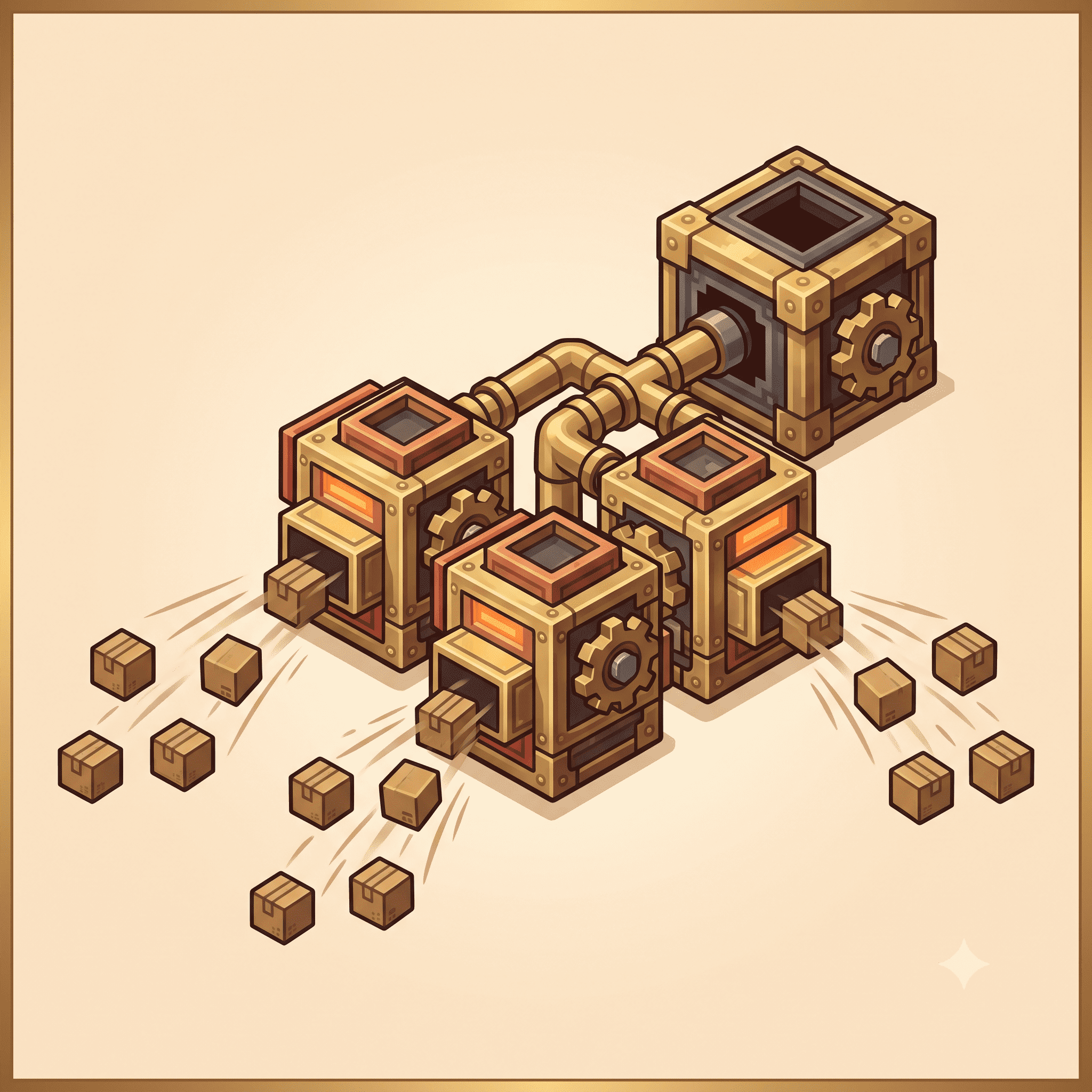
Lets multiple Repackagers sharing one input vault process a single large crafting order in parallel — up to N× faster order fulfillment with N repackagers.
截图
介绍
God Damn Repackager
⚠️ ALPHA
This mod is in early testing. It uses a Mixin to modify Create’s repackager core logic and
has not yet undergone large-scale, long-term stability testing. **Back up your world before
using it.** Bug reports are welcome on the project page.
ℹ️ If you used 0.2.0: 0.2.0 could cause “only some repackagers work after placing an order”
(e.g. 6 of 9) in an existing world, requiring you to re-place the repackagers. Fixed in 0.2.1 —
just upgrade, no re-placement needed. See Known Limitations.
ℹ️ Upgrading from 0.5.0 to 0.5.1: 0.5.1 rewrites the vault identity scheme (from a geometry-derived
BoundingBox to a stable UUID), fixing item duplication/loss bugs that 0.5.0 could hit when reshaping
or partially breaking a vault mid-order. 0.5.0-format SavedData is not compatible with 0.5.1 — on
upgrade, the legacy pool is detected and cleared on load (the log will contain a
[GDR-POOL] detected legacy BoundingBox-keyed SavedDatawarning). Let any active orders finish
before upgrading; the pool is empty after upgrade, new orders work normally.
God Damn Repackager makes all repackagers attached to the same input vault share the work.
N repackagers ≈ N× throughput. Available for both Forge 1.20.1 and NeoForge 1.21.1.
Supported platforms & versions
This mod is maintained for two MC / loader combinations with identical functionality. Pick the
jar that matches your setup.
| | Forge build | NeoForge build |
|—|—|—|
| Minecraft | 1.20.1 | 1.21.1 |
| Loader | Forge 47.x | NeoForge 21.1.x |
| Create (required dep) | 6.0.x (tested 6.0.8) | 6.0.x (tested 6.0.10) |
| Mod version | 0.5.1-forge | 0.5.1-neoforge |
| Jar filename | goddamnrepackager-0.5.1-forge-alpha.jar | goddamnrepackager-0.5.1-neoforge-alpha.jar |
Choose based on whether your pack runs Forge or NeoForge.
If you’re unsure: NeoForge 1.21.1 is recommended for new/single-player packs (more modern);
stick with Forge 1.20.1 for existing saves or Forge-based packs.
Both builds are feature-identical: shared-package-pool parallelism (0.4.0) + partial repackaging
(0.5.0 — start crafting as soon as any materials arrive) + UUID-based vault identity
(0.5.1 — pools survive reshape / partial vault break without duplication or loss).
The Problem
In vanilla Create 6.0+, when you place a large crafting order through the Stockkeeper for your
crafter array (e.g. “craft 1000 iron blocks”), **the entire order is processed by a single
Repackager**. Even if your input vault is surrounded by repackagers, only one of them does any
work — the rest sit idle. A repackager emits only one package per second (20-tick animation
cycle), so large orders take a very long time.
Speed Comparison
| Scenario | Vanilla | With this mod |
|—|—|—|
| 1000 crafts, 1 repackager | ~1000s | ~1000s (unchanged) |
| 1000 crafts, 3 repackagers | ~1000s (2 idle) | ~333s |
| 1000 crafts, 9 repackagers | ~1000s (8 idle) | ~111s |
Usage
No configuration required — works out of the box. Build your crafter array as usual:
Stockkeeper ──order──> Frogport ships materials ──> Input Vault (holds material packages)
                                                          ↓
                                            Multiple Repackagers (redstone block = always on)
                                                          ↓
                                            Packager (unwraps) → Mechanical Crafter → Output
As long as multiple repackagers are attached to the same input vault, this mod automatically
parallelizes them. Repackagers must be placed against a Create Vault.
How it works
Instead of each repackager hoarding an entire order in its own send queue, **0.4.0 uses a per-vault shared
package pool** (stored in the world save):
- Deposit — when a repackager finishes assembling an order’s packages, the whole batch goes into the shared pool keyed by the vault it serves, rather than into its own private queue.
- Poll on demand — every tick, each idle repackager pulls one package out of the pool into its own queue, then ships it as normal. N repackagers genuinely ship N packages/second.
- Inherently dynamic — because each repackager pulls work on demand, a stalled repackager (its downstream clogged) simply stops polling and its work is naturally picked up by idle siblings. No separate rebalance layer is needed.
Partial repackaging (new in 0.5.0): vanilla repackagers wait until ALL of an
order’s material fragments have arrived before doing anything (all-or-nothing). Fragments trickle in
over the transport network, so large orders waste a long “waiting for the last piece” window. 0.5.0
lets repackagers start as soon as the arrived fragments afford at least one craft: available materials
are crafted and shipped immediately, and each newly arrived batch continues the order until it’s done.
Materials are conserved end-to-end — unused leftovers are held in the world save and drop in full if
the vault is broken.
UUID-based vault identity (new in 0.5.1): each vault is assigned a stable UUID and repackagers
find their shared pool by that UUID. The UUID travels with the vault through Create’s multiblock
split/reform hooks — reshaping a vault (adding/removing blocks) leaves the key unchanged, and a partial
break (the remaining blocks re-form into a smaller vault) inherits the original UUID, so the pool keeps
working seamlessly. This fully fixes the 0.5.0 issue where different repackagers saw different geometric
snapshots of the same vault during a reshape, occasionally splitting the pool and causing item
duplication or loss.
Per-block 1/N drain on vault block break (0.5.1 follow-up, “Plan A”): the original 0.5.1 only dropped
the entire pool as PackageItem shells at full teardown (single vault block exploding a backlog exceeding
its own physical capacity, in an unfamiliar entity form). Plan A now drains a 1/N share of the pool
on every vault block break (partial or full), where N is the vault’s pre-break block count: the
packages taken are unpacked to their inner contents (plain ItemStacks, no recipient address) and
dropped as ordinary item entities at the broken block’s position. The remaining blocks re-form into a
smaller vault that inherits the same UUID, and the remaining (N-1)/N of the pool keeps flowing through
repackagers. Breaking the blocks one by one drops 1/N at a time, and the last block (N=1) drains the
remainder — the total dropped equals what “break the whole vault at once” would have dropped. **Reshape
by adding blocks** does NOT drop — the pool migrates to the new shape and keeps flowing. Note: **reshape
by removing a block** follows the same break path, so undoing a reshape will drop 1/N of the pool as
items (pick them up — they’re already-crafted products and usable).
Note on breaking blocks (0.5.1+ Plan A): the shared pool is saved with the world, independent of any block.
Breaking a repackager does not drop the packages still in the pool — they’re kept safely in the save,
and placing the repackager back resumes processing (nothing is lost). When any vault block is broken (either
partial or full teardown), the share of the pool “owned” by that block (1/N of the current backlog, where N is
the vault’s pre-break block count) is unpacked to its inner contents and dropped as ordinary item entities at
the broken block’s position. The remaining blocks re-form into a smaller vault that inherits the same UUID, and
the remaining (N-1)/N of the pool keeps flowing through repackagers. When you break vault blocks one by one,
each break drops its 1/N share, and the last block (N=1) drains the remainder — the total dropped equals what
“break the whole vault at once” would have dropped. Reshape by adding blocks (expanding the vault) does
not drop the pool — it migrates to the new shape and keeps flowing. Note: reshape by removing a block
follows the same break path, so undo a reshape will drop 1/N of the pool as items (pick them up — they’re
already-crafted products and usable). Repackagers respect vanilla Create redstone: they only work when powered.
Installation
Installation is identical for both builds — only the jar and Create version differ:
- Install the matching Minecraft + loader combo (see Supported platforms above)
- Install Create 6.0.x (required dependency; version per the table above)
- Drop the matching
goddamnrepackager-*.jarinto.minecraft/mods/ - Launch the game
Upgrading from 0.2.0? Just replace the jar. 0.2.0 used to require re-placing repackagers in an
existing world; 0.2.1 fixed this — no re-placement needed after upgrade. See
Upgrading from 0.3.x / 0.4.x? Just replace the jar — no re-placement needed, in-flight orders
are unaffected. 0.5.0 adds partial repackaging on top of the shared pool (start crafting as soon
as any materials arrive); you benefit automatically with zero setup.
Upgrading from 0.5.0 to 0.5.1? Just replace the jar — no re-placement needed. However, 0.5.1
switches the vault identity scheme from a BoundingBox to a UUID, so 0.5.0-format pool data is **not
compatible** and will be cleared on load (with a `[GDR-POOL] detected legacy BoundingBox-keyed
SavedData` log warning). Let any active orders finish before upgrading; the pool is empty after
upgrade, new orders work normally.
Compatibility
- ✅ Tested:
- MC 1.20.1 + Forge 47.2.0 + Create 6.0.8
- MC 1.21.1 + NeoForge 21.1.x + Create 6.0.10
- ✅ Tested in modpack environments and on multiplayer servers alongside other mods — no conflicts
- ⚠️ Targets the Create 6.0.x logistics system only; not compatible with Create 0.5.1 and earlier
- ⚠️ Forge 1.20.1 and NeoForge 1.21.1 are maintained independently with identical features; a Fabric port may come later
Known Limitations
Re-place repackagers after installing into an existing world.(Fixed in 0.2.1) 0.2.0 could cause “only some repackagers work after placing an order” (e.g. 6 of 9) in a world that already existed — far more often on multiplayer servers than in fresh single-player worlds. Cause: 0.2.0 identified sibling repackagers by the identity (==) of the Forge capability instance they cached, which is rebuilt whenever the vault’s capability is invalidated, so repackagers placed before the mod existed could hold caches pointing at different generations and fail the check. 0.2.1 fix: siblings are now matched by Create’sInventoryIdentifiervalue equality (for vaults: aBounds(BoundingBox)record comparing only the multiblock’s corner coordinates), which is stable across capability rebuilds. Upgrading to 0.2.1 resolves this — no re-placement needed. (Technical detail in TECHNICAL.md §3.7.)The current implementation is “load-balanced snapshot allocation”…(0.3.0 added dynamic rebalancing on top; 0.4.0 replaced both with a shared package pool) — 0.4.0 deposits each assembled batch into a per-vault shared pool that idle repackagers poll from on demand, giving the same parallel/dynamic-balancing effect with simpler logic.- Breaking a repackager does NOT drop the shared pool (0.4.0). The pool is saved with the world, not tied to the block. Breaking a repackager only drops the single package it was mid-shipping (heldBox); packages still in the pool stay in the save and resume when the repackager is replaced — nothing is lost. Breaking a vault block (partial or full teardown) drops 1/N of the pool unpacked to inner item entities at the broken block’s position (where N = the vault’s pre-break block count; Plan A, 0.5.1+). Each break drops its 1/N share, and the last block (N=1) drains the remainder. Reshaping by adding blocks does NOT drop — the pool migrates to the new shape and processing continues. Note: reshaping by removing a block follows the break path and will drop its 1/N share — pick them up (they’re already-crafted products and usable).
- An order being progressively crafted needs at least one powered repackager (0.5.0). Once an order is “taken over” (partial repackaging has begun), it needs at least one redstone-powered repackager on the vault to keep progressing. Removing all repackagers or cutting their power pauses the order — unused materials stay safely in the world save (and drop if the vault is broken); place a repackager back and power it to resume. Orders without crafting recipes (plain item orders) are never taken over and behave exactly like vanilla.
- Repackagers must be attached to a Create Vault. Other containers (Crates, vanilla chests) are theoretically supported but not fully tested.
License
MIT License — free to use, modify, and distribute. Source code and a full technical writeup
(architecture, dev pitfalls, roadmap) are on the project GitHub.
Credits
- Create and its author simibubi — an outstanding mod that this project builds upon.
常见问题
Create: God Damn Repackager 支持哪些 Minecraft 版本?
Create: God Damn Repackager 支持 Minecraft Java 版 1.20.1–1.21.1,共 2 个版本,可用的加载器:Forge / NeoForge。下载时注意选择和你游戏版本一致的文件。
Create: God Damn Repackager 怎么安装?
先用 PCL2 或 HMCL 启动器安装对应版本的 Forge / NeoForge,再把下载的 .jar 文件放进游戏目录的 mods 文件夹,重新启动游戏即可。开启了版本隔离的,mods 文件夹在 versions/版本名 下面。运行环境:仅服务端。
评论
登录后评论和评分