
Death Logger
Keeps track of your deaths, restores inventory layouts, and saves coordinates, deaths screenshots and more.
截图
介绍
DeathLogger



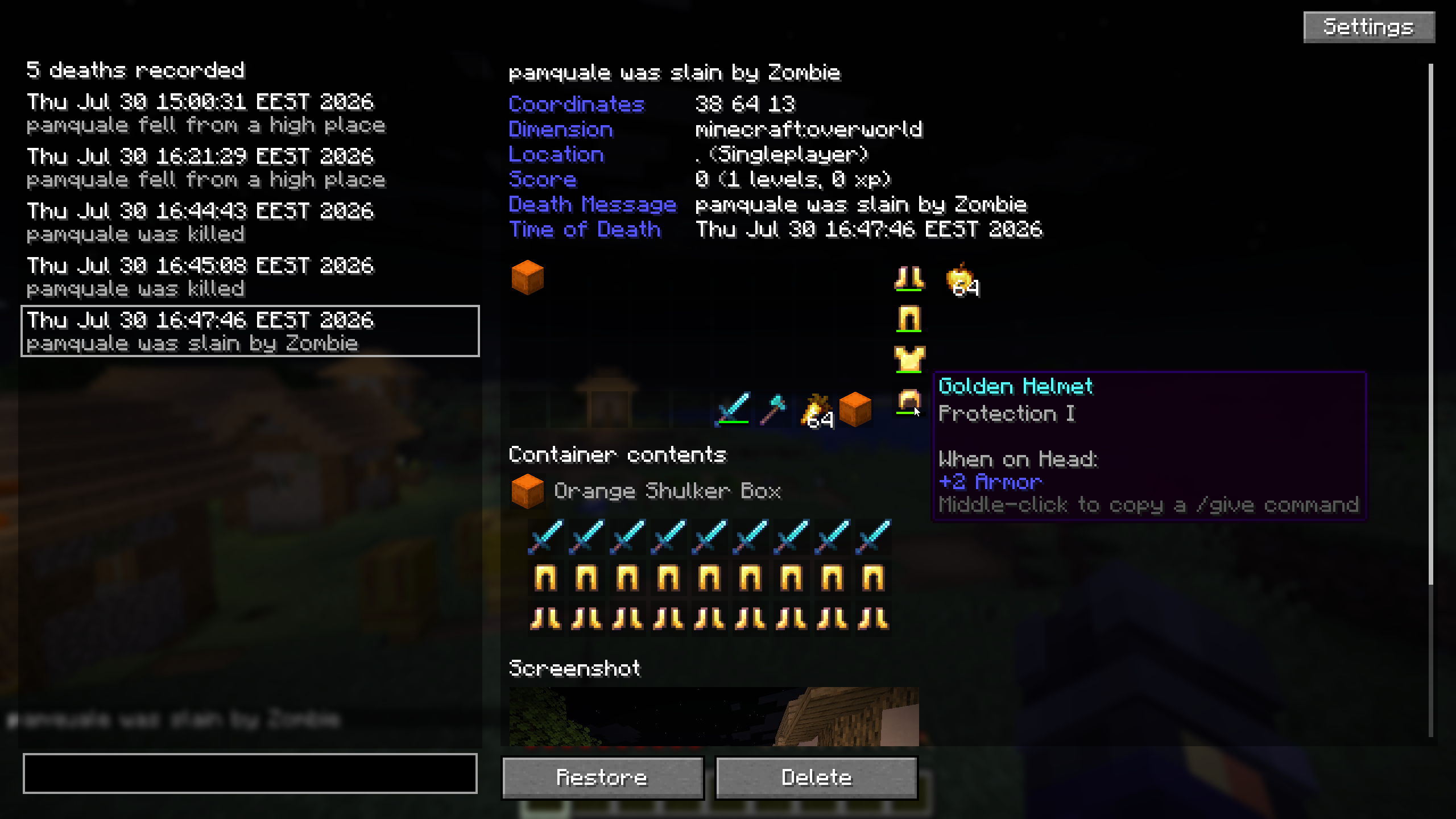
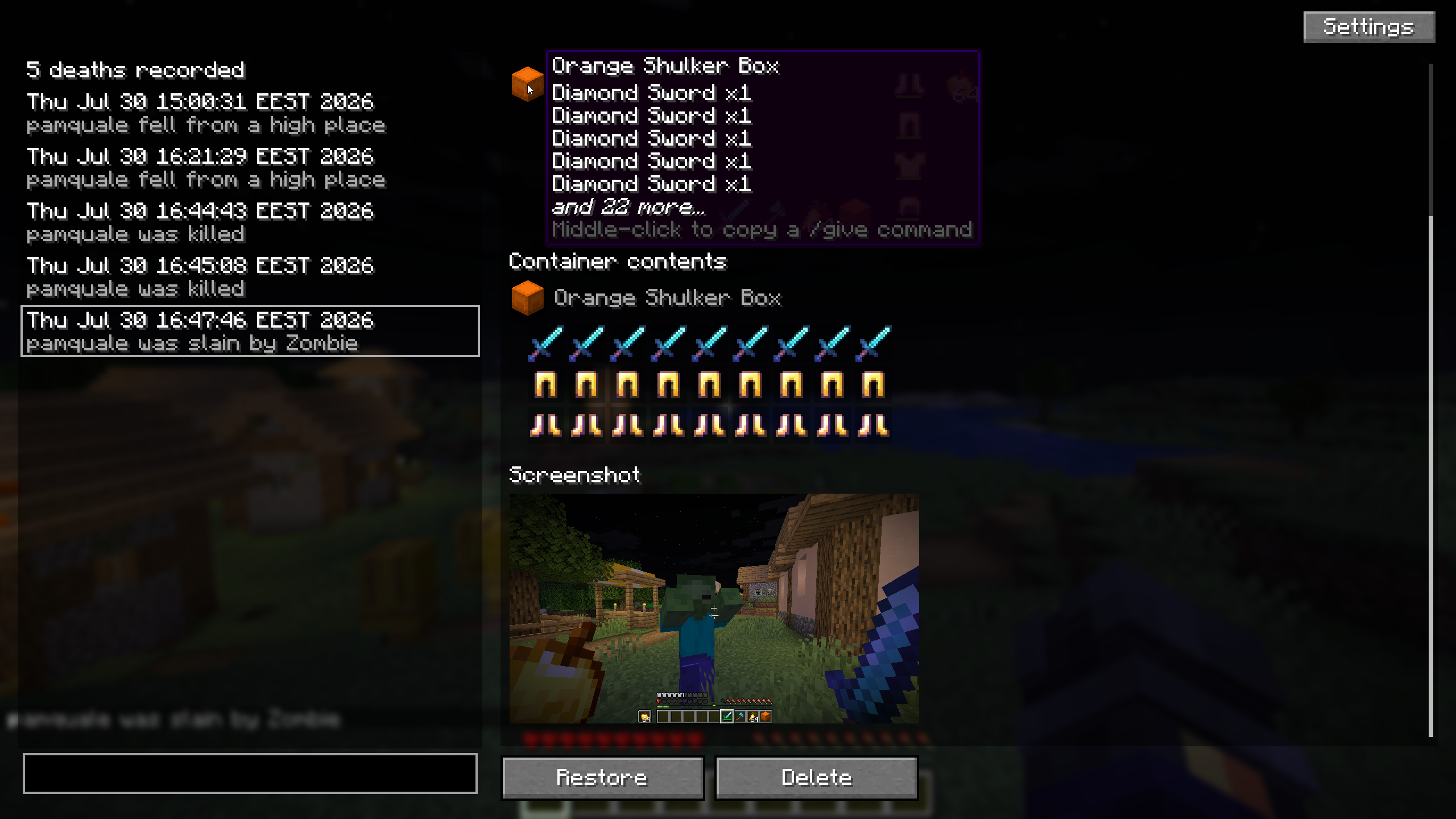
DeathLogger keeps a log of every time you die: when and how it happened, where
you were, your level, everything you were carrying and, optionally, a screenshot
of the moment. You can browse and search the log in game, see what was inside
your shulker boxes and bundles, and put a lost inventory back.
DeathLogger is a rewrite of DeathLog by
glisco03 for Minecraft 26.x, with a new storage format, networking, GUI and a
Fabric/NeoForge/Forge build. The data model and a good part of the design still
come from DeathLog, and its MIT copyright notice is kept in LICENSE.
What gets recorded
Each entry stores the death message, the time, the coordinates and dimension,
the world or server name, your score, level and experience, your main
inventory, hotbar, armour and offhand, and the screenshot if screenshots are on.
On the client, each singleplayer world and each server gets its own log in
<game directory>/deathlogger/, with screenshots in deathlogger/screenshots/.
Servers are told apart by address, LAN worlds and Realms by name. A dedicated
server with DeathLogger installed also keeps one log per player in
<server directory>/deaths/.
Using it
- Open the log with the DeathLogger button on the Statistics screen, or bind a key to it under Controls (it has none by default).
- Select an entry on the left to see its details on the right. The search box matches the death message, time, coordinates, dimension, world name and item names.
- Middle-click an item to copy a
/givecommand for it, including enchantments, names and container contents. - Items the game can no longer read, for example from a mod you removed, show as empty slots but stay in the log, and come back if the mod does.
- The Restore button replaces your current inventory and experience with the ones from the entry, after asking. It works in singleplayer worlds with cheats enabled; on a server, operators restore through the commands below. When it is not available, the button’s tooltip says why. A restored entry shows when and by whom, and restoring it again warns that the items will be handed out twice.
- The Delete button removes the entry and its screenshot, after asking.
- The Settings button opens the options below.
Settings
Stored in config/deathlogger.json. Also reachable from Mod Menu on Fabric and
from the mod list on NeoForge and Forge.
| Option | Default | Effect |
| :– | :– | :– |
| screenshotsEnabled | true | Take a screenshot at the moment of death and show it with the entry. Screenshots are scaled down to about 960 pixels wide when the window size allows. |
| useLegacyDeathDetection | false | Also record a death when your health drops to zero, for servers that never send a death message. Those entries have no cause, and false positives are possible. Has no effect in singleplayer. |
Server commands
By default these need permission level 4. A permission mod can hand them out
separately through the nodes deathlogger.list, deathlogger.view,
deathlogger.restore and deathlogger.delete; the last two also cover the
Restore and Delete buttons in a log opened with view. On Fabric this goes
through fabric-permissions-api (LuckPerms supports it), on NeoForge and Forge
through their PermissionAPI.
/deathlogger list <player> [search]prints a player’s recorded deaths, optionally filtered by the same text the search box uses./deathlogger view <player>opens that player’s log in your own client. Your client needs DeathLogger for this./deathlogger restore <player> <index|latest>restores a recorded inventory. The player has to be online, and their current inventory is replaced.
Requirements
- Minecraft 26.3 and Java 25
- Fabric: Fabric Loader and Fabric API
- NeoForge or Forge: nothing beyond the loader
Optional:
- Better Statistics Screen gets a DeathLogger menu next to File, View and About (Fabric and NeoForge; there is no Forge build of it)
- Mod Menu on Fabric links to the settings
Older Minecraft versions are covered by earlier releases on the
releases page.
Upgrading from 1.0.0
DeathLogger 1.0.0 wrote the deaths from every singleplayer world into one shared
log, deathlogger/deaths_3a52ce7809.dat. Each world now gets its own log. The
shared one is kept as it was, and the death log screen in any singleplayer world
shows an “Older deaths” button that opens it (restoring is disabled there,
since its entries may come from other worlds).
Server logs used to be named after the server list entry, so two entries with
the same name, such as the default “Minecraft Server”, shared a log. They are now
named after the server address, and the old log is taken over the first time you
join the server.
Upgrading from 0.4.x
Logs written by DeathLogger 0.4.x are converted the first time they are opened,
and the original file is kept as <name>.r3.bak. Their items are upgraded from
1.21.11; anything that can’t be upgraded stays in the log as an unreadable slot.
0.4.x logs for worlds and servers are picked up again the first time you open
that world or join that server.
Building
./gradlew buildThe jars end up in fabric/build/libs, neoforge/build/libs and
forge/build/libs. The Minecraft version and all dependency versions are set in
gradle.properties.
common holds the code shared by all loaders, compiled against vanilla
Minecraft. fabric, neoforge and forge add each loader’s entry points,
networking and platform hooks. compat-betterstats is compiled into the Fabric
and NeoForge jars only.
License
MIT, see LICENSE.
Credits
- glisco03, author of DeathLog, the original mod this one is based on
- pamquale, DeathLogger author and maintainer
常见问题
Death Logger 支持哪些 Minecraft 版本?
Death Logger 支持 Minecraft Java 版 1.21.1–26.3,共 15 个版本,可用的加载器:Fabric / Forge / NeoForge。下载时注意选择和你游戏版本一致的文件。
Death Logger 怎么安装?
先用 PCL2 或 HMCL 启动器安装对应版本的 Fabric / Forge / NeoForge,再把下载的 .jar 文件放进游戏目录的 mods 文件夹,重新启动游戏即可。开启了版本隔离的,mods 文件夹在 versions/版本名 下面。运行环境:客户端 / 服务端。

评论
登录后评论和评分