
Armor Model API
Renders Bedrock/GeckoLib geo armor models through the vanilla armor pipeline.
截图
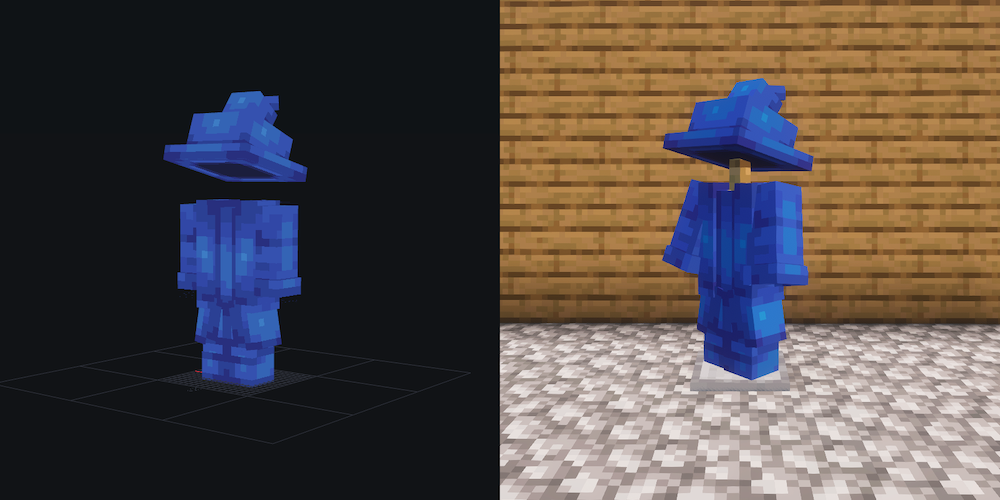
介绍
Armor Model API
Renders armor with custom geometry authored in the Bedrock/GeckoLib .geo.json format, through the vanilla armor rendering pipeline.
Capabilities
- Custom armor geometry per armor set: robes, pauldrons, hats, skirts — any cuboid-based Blockbench model
- Per-slot rendering with the standard armor bone convention, including separate boot bones and a chest-anchored waist bone for leg pieces
- Armor trims with per-set trim textures (vanilla smithing-table trims, your art)
- Emissive glowmasks — the hand-authored
_glowmask.pngconvention; pixels that stay bright in the dark - Radiant glow — a high-luminance variant that burns toward white and feeds shader-pack bloom
- Custom render layers — a small interface for adding your own passes (extra overlays, effects)
- Everything vanilla armor does comes for free: pose and animation following, sneaking/swimming, armor stands, baby mobs, dyed leather color, enchantment glint, the glowing outline effect
How it works
- Loading — on resource load (and every F3+T reload), each registered
.geo.jsonis parsed and baked once into a vanillaModelParttree (the sameTexturedModelDataevery vanilla entity model is built from), cached until the next reload. Textures are plain resources, resolved by the render layers on demand — nothing is preprocessed. - Hooking in — when an armor piece is about to render, the library steps in per registered item: on Fabric through Fabric API’s
ArmorRendererhook, on NeoForge through a small equivalent mixin. Vanilla’s overlay rendering is skipped for that piece and the dispatcher renders the baked model instead — vanilla pose copied on, slot visibility applied. Unregistered items are untouched. - Pass order — each piece draws as a stack of passes over the same model: base texture → your render layers (glow, then trim so it lands on top), with enchantment glint riding the base pass. Renderers built through the fluent API keep the layers sorted into that stack automatically; a renderer constructed with an explicit layer list draws them in list order (see Render layers). Every extra pass is just the model rendered again with a different render layer and buffer.
From bake to buffer this is 100% the vanilla code path — the same pose copy, render layers, and buffers vanilla armor uses. That is the whole compatibility and performance story: Sodium, Iris, and anything else that works with vanilla armor sees ordinary vanilla model rendering. There is no custom vertex pipeline.
For developers
For developer documentation, check out the GitHub readme.
常见问题
Armor Model API 支持哪些 Minecraft 版本?
Armor Model API 支持 Minecraft Java 版 1.20.1–26.3,共 8 个版本,可用的加载器:Fabric / Forge / NeoForge。下载时注意选择和你游戏版本一致的文件。
Armor Model API 怎么安装?
先用 PCL2 或 HMCL 启动器安装对应版本的 Fabric / Forge / NeoForge,再把下载的 .jar 文件放进游戏目录的 mods 文件夹,重新启动游戏即可。开启了版本隔离的,mods 文件夹在 versions/版本名 下面。运行环境:客户端和服务端都要装。
ZsoltMolnarrr 的其他作品
查看全部 →
Spell Engine
🪄 数据驱动的魔法前置库

Spell Power Attributes
法术强度实体属性,以及相关的状态效果和附魔

Runes
🪨 制作符文作为法术的弹药

Wizards (RPG Series)
🧙🏻♂️ 用奥术、火焰和冰霜魔法摧毁你的敌人
评论
登录后评论和评分