Tycoon Exchange
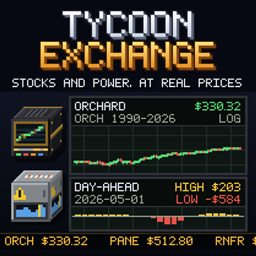
A stock exchange and a power market for Minecraft: trade 32 stocks at the Broker Terminal and sell your machines' power through the Grid Connection at the day-ahead price of the hour.
介绍
Tycoon Exchange
Real prices. Your money.
Tycoon Exchange puts two real markets into Minecraft. At the Broker Terminal you trade 32 stocks whose
daily closing prices follow real history from 1990 on. With the Grid Connection you sell your machines’
power at the real day-ahead electricity price of the hour. Hold a stock for decades, short a crash, or feed
a whole country with power.
The Broker Terminal
32 companies, from tech and energy to banks, retail, pharma and aircraft, each with a daily closing price
from 1990 (or from its stock market debut) to 2026-10-01. The names in the game are made up; the prices
behind them are the real ones.
- Real history: a stock is tradable from its first real trading day. Dividends are paid on their real dates, splits happen as they really did – your shares multiply
and the chart is split-adjusted. Three companies go bankrupt on their real dates, and what you hold
in them is worth nothing from then on. - Beyond today the market is simulated from each company’s own trend and volatility plus a shared market
mood, fixed per world seed. - Your orders move the price. An order the size of a whole trading day moves it by about 10 percent, and
the move fades over a few days. Buying and selling straight back only costs the broker fee (0.1 percent,
at least $1). - Short selling and leverage up to 5x. Leverage costs 8 percent interest a year on the loan, shorting a
3 percent borrow fee, and shorts pay the dividends. Below 15 percent equity the portfolio warns you; below 10 percent
the position is closed by force. A loss beyond your
account stays as a debt with the broker. - Market tab: every company with price, daily change and a chart (1 month to the whole history); enter
shares and leverage, then buy, sell, short or cover. Portfolio tab: all positions with value, equity,
margin and profit or loss, plus dividends and interest.
The Grid Connection
Feed power into it and it turns the energy into dollars – at the real German day-ahead electricity price of
the current hour, converted at the exchange rate of the day. Prices are real hourly data from 2015
(estimated before), simulated beyond today. 1 kWh is 1,440,000 FE. The hour follows the Minecraft
clock: noon is cheap, evening is expensive.
Incoming power goes through three layers:
- Contract customers – tenants (evenings), a factory (weekdays) and a data centre (round the clock) ask
for contracts every week. They pay a fixed price for a year but want power every hour; what you cannot
deliver is bought as expensive balancing energy. - The exchange – the rest goes into the market of your voltage level. Its size follows the real German
load profile, and the more of it you supply, the less every kWh is worth. - Drawing from the grid (switch) – buy power at the exchange price plus a grid fee to fill your storage
when it is cheap. Power you bought is never paid again as delivery.
At negative prices feeding in costs money; a switch lets the connection stop. Price limits set when it
feeds in and when it draws.
Four tiers: low, medium, high and extra-high voltage – a local grid, a town, a region, a whole country.
Each carries more power, serves a bigger market, charges lower fees and signs more contracts. Upgrading is a
button on the screen and costs money; the tier stays with the block. Three tabs (overview with the day’s price
curve, customers, settings) and a hint for every line.
Crafting
- Broker Terminal: gold ingots, a glass pane, emeralds, a comparator and iron ingots.
- Grid Connection: iron ingots, a lightning rod, copper blocks and a redstone block.
For servers and pack makers
- Config (
tycoonexchange-common.toml): commission, maximum leverage, interest, borrow fee, margin
limits, market impact and its decay; for power the game factorpriceMultiplier(real prices are tiny
next to Minecraft machines, default 40), market size, power, upgrade price, fees and contracts per tier. - Tycoon Skills (optional): a skill tree can hold back the upgrades to medium, high and extra-high
voltage with the keystycoonexchange_medium_voltage,tycoonexchange_high_voltageand
tycoonexchange_extra_high_voltage. - Other power mods connect through the standard FE capability. All data ships inside the mod.
Requirements
- Minecraft 1.21.1, NeoForge
- Money (required) – accounts and payments
- Tycoon Calendar (required) – the date of the market
- Tycoon Skills (optional) – skill-gated grid upgrades
Works in singleplayer and multiplayer; everything is kept on the server.
Data and credits
Stock prices are public daily chart data; three companies that no longer exist are reconstructed from known
closes. Electricity prices: Energy-Charts (Fraunhofer ISE) with data from the Bundesnetzagentur / SMARD.de
(CC BY 4.0). Exchange rates: ECB reference rates.
A note on how this was made
This mod was built with substantial help from AI. The design decisions, the playtesting and the
direction are mine; a large share of the code, the textures and this text was written with an AI
assistant. I would rather say that plainly than have you wonder.
Discord
Questions, bug reports, ideas, or just want to show what you built? Join the Discord –
that is where I answer fastest, and where the next version gets shaped.
常见问题
Tycoon Exchange 支持哪些 Minecraft 版本?
Tycoon Exchange 支持 Minecraft Java 版 1.21.1,可用的加载器:NeoForge。下载时注意选择和你游戏版本一致的文件。
Tycoon Exchange 怎么安装?
先用 PCL2 或 HMCL 启动器安装对应版本的 NeoForge,再把下载的 .jar 文件放进游戏目录的 mods 文件夹,重新启动游戏即可。开启了版本隔离的,mods 文件夹在 versions/版本名 下面。
Reinay97 的其他作品
查看全部 →
Money – Cash, ATM & Accounts
Coins, notes, a purse, an ATM and a money API

Tycoon Calendar
A shared in-game calendar: your world gets a real date that every mod can use for prices, rents and birthdays.
Tycoon Market
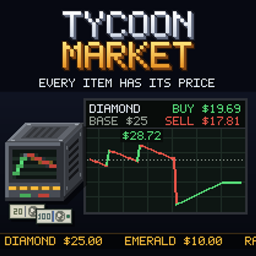
Every item has a price that moves with trade. Buy and sell at the Market Terminal, sell farm output through the Market Depot, fulfil daily contracts, and let auto-buy feed the Litematica printer.

Data Center
Data Center turns compute into a real SkyBlock resource: build server Racks, power and cool them, then route compute over a bandwidth-limited cable network to Synthesizers for materials or Mining Rigs/Hosting Racks for real crypto income
评论
登录后评论和评分